There’s a story I’ve always loved about a performance of music by Johannes Brahms.
During one section of the symphony, the score instructs the orchestra: “As loud as possible.”
The conductor that evening was the legendary Eugene Ormandy, who led the Philadelphia Orchestra for decades and was known for conducting with enormous physical energy.
When the orchestra reached that passage, Ormandy leaned into it, urging the musicians to give the music everything they had.
Then a few measures later came another instruction in the score.
So Ormandy pushed harder.
He drove the orchestra forward with such intensity that in the middle of the performance he literally threw his shoulder out of joint while conducting.
The press had a field day with the story afterward. Reporters asked him what it felt like to dislocate his shoulder during a performance.
Ormandy’s response was unforgettable:
“I know some people who have reached middle age who have never been enthused enough to dislodge a necktie, not to mention a shoulder… so I feel pretty good about it.”
Not their title.
Not their strategy.
Not even their experience.
Their energy.
You can feel it the moment a leader walks into the room.
Energy communicates belief.
Energy communicates urgency.
Energy communicates whether something actually matters.
When a leader shows up with enthusiasm, it does three powerful things:
At ADDO, one of our core values is passion—the willingness to bring energy and enthusiasm to the work that matters.
Not artificial hype.
Not forced motivation.
Real enthusiasm that comes from believing deeply in what you’re doing and the people you’re doing it with.
Because the truth is, a lot of people go through life at half volume.
They show up to work, but cautiously.
They lead teams, but without visible belief.
They pursue goals, but without much fire.
They’re technically present, but emotionally disengaged.
And over time that quiet disengagement spreads through organizations like gravity.
Leaders set the tone.
When a leader is energized, curious, and passionate, it lifts everyone around them.
When a leader is flat, distracted, or indifferent, that spreads too.
Which leads to a simple but powerful question:
Here are a few areas worth evaluating.
Your Work: Do people see that you genuinely believe in what you’re building?
Your Team: Does your energy communicate confidence in them?
Your Clients or Customers: Do they feel that you care deeply about the experience you’re creating?
Your Life Outside Work: Are you showing up fully for the people and moments that matter most?
Because leadership, like great music, is rarely about playing it safe.
Sometimes the moment calls for you to lean in, raise the energy, and push for something just a little bigger.

About six months ago, after much resistance, I started wearing a Whoop. It is a fitness wearable…other people might use something like an Apple Watch or an Oura Ring.
I’ve genuinely enjoyed the insights. Sometimes it reminds me I didn't move enough during my day. Other times it surfaces a trend that I end up feeling a few days later.
The other night, however, it was flat-out wrong.
I woke up to a "green" recovery score, meaning the data said I'd had a great night of sleep. High HRV, low respiratory rate, blah blah blah. Basically, all the right numbers were right.
The problem? I knew I didn't sleep well. I tossed and turned all night. The Whoop was wrong.
That moment reminded me of Jeff Bezos line that has stuck with me:
Because behind every data point is a human experience. And when we ignore that experience, we don’t become more objective, we become more disconnected.
Data is only as good as the questions we ask.
If you measure customer satisfaction with a single score, you might miss an underlying frustration.
If you only track employee engagement through surveys, you might overlook what’s really happening in the hallway conversations.
If you singularly optimize for efficiency, you might accidentally destroy loyalty.
The issue isn’t that data is misleading, it’s that it’s incomplete.
Metrics can tell you what is happening.
Anecdotes often tell you why.
And if you don’t understand the why, you’re just guessing with better spreadsheets.
There’s an old truth worth revisiting:
I’d add a modern layer to that.
A person with experience shouldn’t be overruled by someone with a perfectly formatted dashboard either.
Because firsthand experience carries context. Emotion. Nuance. It captures what can’t always be quantified.
A frontline employee who says, “Customers are getting frustrated,” is offering something no metric fully captures.
A leader who says, “This doesn’t feel right,” may be picking up on signals the system hasn’t learned to detect yet.
The best organizations don’t choose between data and anecdotes. They interrogate the gap between them.
When the numbers say one thing but people are experiencing another, that’s not a nuisance. It’s a signal.
It’s an invitation to ask better questions. Are we measuring the right outcome? Are we missing a variable? Are we simplifying something that is inherently complex?
Too often, organizations double down on the data because it feels safer. Cleaner. More defensible.
But the real work, the meaningful work, is in sitting with the tension long enough to uncover what’s actually true.
Even in the most data rich environments in the world, context still matters.
Human behavior is messy. It’s dynamic. It doesn’t always fit neatly into categories or models.
And that’s exactly why anecdotes matter.
They restore the story behind the statistic.
They remind us that we’re not just managing systems, we’re serving people.

In leadership, there are two very different kinds of power.
One comes from a title. The other comes from influence.
The first is positional power. It is granted by an organization chart, a promotion, or a new line on a business card.
The second is personal power. It comes from trust, credibility, and the way people experience your leadership.
The truth is simple.
And the difference between the two becomes more obvious the higher someone rises in an organization.
Few leaders in modern history carried more positional power than Margaret Thatcher. As Prime Minister from 1979 to 1990, she led during one of the most consequential periods in modern British history and earned the nickname “The Iron Lady” for her strength and resolve.
Yet one of her most famous observations about power reveals something deeper about leadership:
“Being powerful is like being a lady. If you have to tell people you are, you aren’t.”
It is a sharp insight into human nature. The moment a leader has to constantly remind people of their authority, their rank, or their title, something is already off.
Real leadership rarely has to announce itself. People feel it.
In his research on great companies, Jim Collins described different levels of leadership. Level 3 leaders are competent managers who organize people and resources effectively to accomplish goals. Level 4 leaders are strong executives who rally teams toward ambitious objectives.
Both are important. But the most transformative leaders operate at what Collins calls Level 5.
Level 5 leaders combine fierce professional will with deep personal humility. They focus less on their own power and more on building something that lasts. People follow them not because they must, but because they want to.
Many leaders fall into a quiet trap. Early in their career they develop influence because they have to. They persuade, collaborate, and earn trust.
But once they gain a title, they begin leaning on it.
“Because I said so” slowly replaces “Here’s why this matters.” Authority replaces influence. And the very leadership muscle that built their success begins to weaken.
That requires personal power.
If you think about the leaders who shaped your life, most of them did not do it because of their title. A teacher, coach, mentor, manager, or pastor likely influenced you because of how they treated people, the standard they lived by, and the belief they had in others.
Their influence made their leadership credible.
So the question is worth asking for anyone leading in a business, school, church, or nonprofit.
Are you working harder to grow your positional power or your personal power?
Positional power is granted. Personal power is earned. It grows through character, consistency, and the way people experience you over time.
Ironically, when leaders focus on increasing personal power, positional power often follows. Organizations tend to elevate people whose influence lifts others.
But when leaders chase the title without building the influence, the title becomes the only thing holding their leadership together.
And that is a fragile place to lead from.
So spend less time trying to prove you are the leader.
Spend more time becoming the kind of person people want to follow.

In business, we are wired to solve problems.
If a metric drops, we investigate.
If a complaint appears, we respond.
If something breaks, we fix it.
That instinct is necessary. Organizations have to address problems and close gaps.
But there’s a subtle trap: many organizations spend most of their energy decreasing negative variance by fixing what’s wrong and very little time increasing positive variance by understanding what’s working.
We get really good at studying failure.
And we spend very little time studying excellence.
In Switch, Chip Heath and Dan Heath introduce the idea of Bright Spots.
A bright spot is simply a moment where something is already working better than expected.
Instead of asking “What’s the problem?” bright spot thinking asks:
Where is this already working?
What can we learn from it?
Problems feel overwhelming. Success feels replicable. When you focus only on what’s broken, the organization feels stuck. When you identify what’s working, you suddenly have a model you can replicate and amplify.
Most businesses unintentionally build systems around problem detection. We track complaints, failures, missed goals, service breakdowns, and negative feedback.
Those things matter.
But imagine if a doctor only studied illness and never studied health.
That’s what many organizations do.
When a guest has a terrible experience, the story spreads across dashboards and meetings. But when a team member creates an unforgettable experience for a guest, the kind that builds lifelong loyalty, it often passes quietly.
No investigation.
No replication.
No scaling.
The bright spot disappears.
At ADDO we believe something simple but powerful: excellence leaves clues.
Somewhere in your organization right now, a frontline employee consistently creates memorable experiences. There’s one location that outperforms others in guest satisfaction. It might be a team member turns frustrated guests into loyal advocates. In larger organizations, one leader has created a culture people love being part of.
The question is not if bright spots exist. The question is whether we are looking for them. Once you find them, better questions emerge.
What exactly did they do differently?
What behaviors made the difference?
What systems supported the success?
Bright spots give you a blueprint.
The goal is not to ignore problems. The goal is balance.
One approach stabilizes the system. The other elevates it.
When we talk about the Guest Experience at ADDO, bright spots become incredibly powerful. Every organization has stories where a routine transaction became a moment of care. A frustrated guest left feeling valued. A frontline employee chose empathy instead of efficiency.
Those moments matter. Not just because they are encouraging stories, but because they show us what is possible.
If it happened once, it can happen again. And if we learn from it, it can happen everywhere.
One of the most important habits leaders can develop is this: become a bright spot hunter.
Instead of asking only “What went wrong?” also ask:
Who created a remarkable moment this week?
Where did we exceed expectations?
What story deserves to be told across the organization?
When leaders spotlight excellence, people do not just hear about the standard. They see it. And when people see it, they start repeating it.
The organizations that create extraordinary cultures and experiences are not the ones that eliminate every problem.
They are the ones that find what works and amplify it.
They study excellence.
They replicate success.
They turn bright spots into cultural norms.
Because sometimes the fastest way to improve an organization is not fixing what is broken.
It is doing more of what already works.

Ambition is one of the most complicated qualities a leader evaluates in younger talent. It tends to reveal itself most clearly at the beginning of a career, both to the person carrying it and to the people paying attention.
Some of you reading this might be the boss who is responsible for evaluating ambition. Or maybe you’re the young professional trying to prove it. Either way, our understanding of ambition, and our approach to it, matters more than we think.
Too little of it is obvious.
Too much of it can be harder to recognize.
When I look at emerging leaders, I often feel the tension between two extremes.
On one end are individuals who seem comfortable doing only what is required. They show up, complete their assignments, and go home. There’s little evidence of stretching beyond the job description. No outside involvement. No extra curiosity. No desire to take on something difficult simply for the sake of growth.
It raises a quiet but important question: Are they truly ambitious?
But the other end of the spectrum is just as concerning.
These are the young professionals who are constantly working. Every hour is filled. Every opportunity is pursued. Their calendars are packed, their productivity is relentless, and their drive is unquestionable.
Yet sometimes I find myself wondering something different about them:
Because unrestrained ambition can quietly become a trap. It can push someone to pursue the accumulation of wealth, power, or prestige without ever asking whether those things actually lead to the life they want to build.
In other words, some people are not ambitious enough.
And some people are ambitious in the wrong direction.
The most compelling perspective I’ve seen on this tension comes from the work of Praxis and its co-founder and CEO, Dave Blanchard. Praxis teaches what they call Redemptive Leadership, and their view of ambition reframes the entire conversation.
They describe it this way:
“We surrender our personal ambition to God and seek first the good of others, not ourselves. Instead of privately yielding our desires to an accumulation of wealth, power, and prestige, we cultivate gratitude, joy, and humility in the way we lead and serve.”
That idea captures the tension beautifully.
Redemptive ambition doesn’t eliminate drive. In fact, it often sharpens it. But it redirects it.
That distinction matters enormously when evaluating young talent.
The person who appears unambitious may simply lack vision. They haven’t yet discovered a purpose large enough to ignite their effort.
But the workaholic may have the opposite problem. Their ambition is burning hot, but it’s pointed toward metrics that won’t ultimately satisfy them: titles, recognition, or the next promotion.
The leaders I’m most excited about are usually found somewhere in the middle.
They work hard, but they’re not consumed by work.
They pursue excellence, but not applause.
They care about achievement, but also about people.
Their ambition is not just upward.
It’s outward.
They invest in their communities. They build relationships. They look for ways their success can benefit others.
That kind of ambition tends to produce not just strong professionals, but strong lives.
And when you see it early in someone’s career, you’re not just looking at talent.
You’re looking at a future leader.

Last week I was in Austin, TX with leaders in the convenience store industry. Later in the week, I was with a couple hundred bankers in Charlotte.
On the surface, you couldn’t pick two more different rooms.
In Austin, they talked about fuel margins, food programs, labor turnover, and the constant motion of high-volume retail. Convenience is fast, high traffic, and nonstop customer interaction.
In Charlotte, the conversations centered on regulation, risk, trust, digital transformation, and long-term relationships. Banking feels more formal. The pace is different. The scrutiny is intense.
Convenience runs on speed and simplicity.
Banking runs on precision and trust.
Different industries. Different pressures. Different languages.
So you might assume they need completely different leadership messages? They don’t.
Because if you lead a customer-facing, geographically dispersed workforce, whether in convenience, restaurant, retail, grocery, banking, hospitality, healthcare, or education, you’re solving the same core challenges.
You’re trying to align thousands of human interactions, across multiple (sometimes hundreds) of locations, around one shared objective.
And that always comes back to three things.
Frontline work can easily become transactional.
Scan the item.
Process the deposit.
Turn the room.
Move to the next patient.
But when people believe their work matters, performance changes.
The cashier isn’t just selling coffee, they’re starting someone’s day.
The banker isn’t just opening accounts, they’re creating stability.
You can’t force people to care. But you can consistently connect their daily tasks to a bigger why. Purpose fuels resilience when the shift is long and the customer is difficult.
Senior leaders speak in strategy. Frontline teams live in moments.
If growth goals, service standards, or efficiency metrics aren’t translated into clear, practical expectations, they die in the middle layer. This is one of the key reasons that people hire ADDO to improve their guest experiences.
The question isn’t “Did we communicate it?”
The question is “Can the person at the counter explain it and act on it?”
Clarity wins in dispersed organizations.
Alignment breaks down when one of these is missing:
Most organizations train skill. Fewer cultivate will. Even fewer think about thrill.
But sustainable performance requires all three.
High skill without will leads to disengagement.
Will without skill leads to frustration.
Skill and will without thrill eventually lead to burnout.
The best leaders develop competence, connection, and energy together.
Here’s what struck me moving from Austin to Charlotte:
The industries look different. The terminology changes. The pressure points shift. But the fundamentals don’t.
If you can connect people to purpose, translate strategy clearly, and build skill, will, and thrill, you can create alignment in any organization, in any industry, where people are working together toward a common goal.

I was on a Delta flight recently, standing in the aisle as people shuffled to their seats, bags overhead, headphones going on. Before we ever left the gate, the flight attendant came on the intercom and announced our destination.
Then she did it again.
And again.
“Ladies and gentlemen, this flight is headed to Washington D.C. If this is not your final destination, now is the time to exit the aircraft.”
At first, it felt repetitive. But the longer I sat there, the more it struck me as profound leadership.
The flight attendant wasn’t just being redundant, she was being clear.
She wanted to make sure that everyone on that plane was aligned with where it was going. And if you weren’t intending to end up at that destination, she gave you the opportunity to step off.
That’s what great leaders do.
Whether you’re leading in business, education, or ministry, one of your most important responsibilities is to continually remind people where you’re going.
Vision isn’t something you announce once at the beginning of the year and then assume everyone remembers. People forget. Distractions creep in. Priorities drift. When leaders stop casting vision, misalignment grows quietly, and often painfully.
Clear vision:
When people know the destination, they can decide how to show up, how to contribute, and how to commit.
There’s another side to that flight announcement that matters just as much.
By clearly stating the destination, the airline gave people permission to leave if they realized, This isn’t where I want to go.
That’s not failure. That’s honesty.
As leaders, we often fear that clarity will push people away. But ambiguity does far more damage than truth ever will. When you cast vision consistently, you give people the dignity of choice. They can either lean in or step out.
And that’s healthy.
Here’s the hard but freeing truth: some people are only meant to be with you for a season.
That’s not an indictment against you.
And it’s not a problem with them.
They may simply want to go somewhere else.
When that happens, it doesn’t mean the mission is wrong or the relationship was wasted. Seasons change. Callings evolve. Destinations differ.
And here’s the part we often forget: there might be someone on standby, watching, ready, hoping for the very seat that just opened up.
Jim Collins famously said great leaders focus on “getting the right people on the bus.” I’d add this: sometimes you need to make sure you have the right people on the plane, headed to the same destination you’re committed to reaching.
Cast the vision.
Say it often.
Say it clearly.
And trust that the people who are meant to be on the journey with you will stay onboard.

I give Aaron Fossas on our ADDO team a hard time (regularly) about getting obsessed with certain strategies, terms, or phrases.
If something works, Aaron doesn’t just use it, he obsesses over it. He’ll repeat it, refine it, and push it until it either breaks or becomes a core principle.
One word he brings up a lot?
Monomaniacal.
And I have to admit, it’s growing on me.
Monomaniacal means having an almost obsessive focus on a single idea, goal, or pursuit. Not distracted focus. Not casual interest. Relentless, intentional concentration.
The kind of focus where you’re willing to say no to good ideas in service of the one that actually matters.
That level of focus represents clarity.
It represents conviction.
And it usually represents uncomfortable discipline.
A great example is Todd Graves, the founder of Raising Cane’s, which he talked about on the Founders podcast. The man built a multi-billion-dollar business by being obsessed with… chicken fingers.
Not burgers.
Not breakfast.
Not salads.
Not seasonal experiments.
Chicken fingers.
As someone with a pretty simple palate, I can appreciate that kind of commitment.
He didn’t try to be everything. He tried to be the best at one thing.
That monomaniacal focus shows up over and over again in great businesses and leaders:
None of these were accidents. They were choices.
And this is where people often get it wrong:
Simple doesn’t mean dumbed down.
Simple means focused.
Simple means prioritized.
Simple means you’ve done the hard work of deciding what actually matters and letting the rest go.
So yeah, I might still give Aaron a hard time about his favorite buzzwords.
But if being monomaniacal leads to clarity, excellence, and results?
I’m starting to think he might be onto something.

We’re a month into 2026. Are you already feeling it? You had goals and strategic priorities energizing the start of the year. Now the lists are getting longer, the demands getting more frequent, the commitments stacking up. The momentum of a new year has a way of quietly turning into overload.
So today, I want to challenge a familiar habit.
Most of us live by a to-do list. We measure progress by what we add. But what if real progress this year isn’t about what you start… but what you stop?
I know it is hard, trust me. I love to start things.
New businesses. New programs. New ideas. As an entrepreneur, "beginning" feels like momentum, progress, possibility. And honestly, starting comes naturally to me.
But stopping?
Pruning?
Letting go?
That’s the part I still struggle with.
I have been working on writing a new book for over a year, and getting it across the finish line is taking longer than it should. I am accepting that the only thing that will help get it done is by finding things on my to-do list that I can stop doing.
At some point, whether we acknowledge it or not, we hit capacity. Our plates (and calendars) don’t get magically bigger just because we have another good idea. And sometimes the best leadership move isn't to start the next thing… it’s to stop the current one.
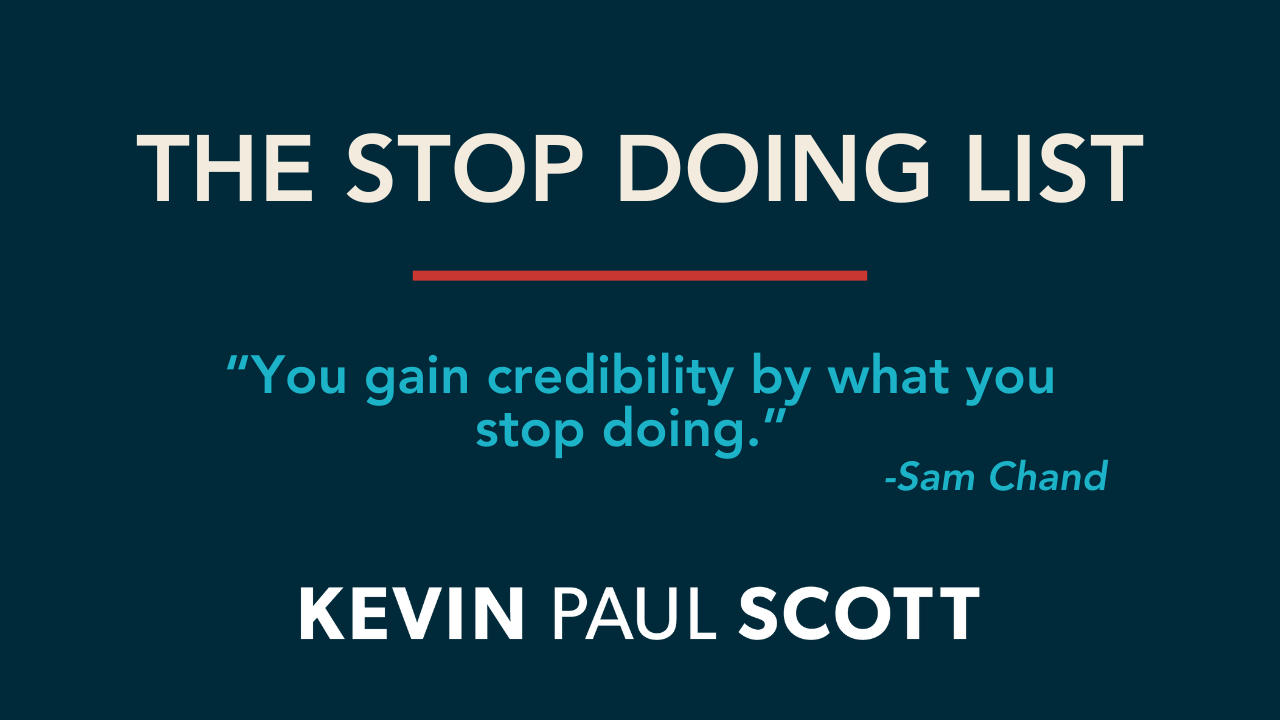
My friend Sam Chand says,
Why? Because stopping shows clarity. Stopping shows conviction. Stopping shows that you’re committed enough to the right things that you’re willing to release the less important things.
This isn’t just a leadership idea, it’s a biblical principle.
In John 15, Jesus describes pruning:
It’s counterintuitive.
The branch is productive. It’s working. It’s not failing.
But it still gets cut back.
Gardeners understand this truth. But leaders often ignore it.
We keep adding.
We keep pushing.
We keep starting.
And without pruning, eventually even good branches become overloaded.
So here’s the challenge:
A list of things you will intentionally stop doing so you can protect the energy, clarity, and focus needed for the things that matter most.
Your future impact might not depend on what you start next…
but on what you stop now.